EN
EN English
  русский
  Español
  عربى
عربى 
When installing PVC soffit and vinyl siding, selecting the correct receiving channel is critical to ensuring a professional, durable finish. The question often arises: should you use an F channel or a J channel? The answer depends on your specific project requirements, local climate conditions, and installation context. F-channel is purpose-built for soffit receiving, featuring a dedicated slot with structural support that prevents panels from lifting under wind pressure. J-channel, by contrast, is a universal trim designed for siding edges, window and door perimeters, and can be adapted for soffit use when necessary. This comprehensive guide explains the differences between these two channels, their respective advantages and limitations, and how to select the right choice for your soffit installation to ensure long-term performance and aesthetic quality.
What Is the Difference Between F Channel and J Channel?
Understanding the structural and functional distinctions between F-channel and J-channel is essential for making an informed installation decision. Both are aluminum or vinyl trim components, but they serve different primary purposes in the building envelope.
J-Channel: The Universal Trim Solution
J-channel derives its name from its J-shaped cross-sectional profile. This versatile trim is engineered to wrap around siding edges, frame openings like windows and doors, and provide a finished appearance along fascia boards. When viewed from the side, the channel resembles the letter "J," with one leg designed for nailing to the structure and another forming the receiving slot for siding or soffit panels.
Key Characteristics of J-Channel:
Universal application across multiple trim scenarios
Single receiving slot with moderate depth
Friction-fit design relies on tight panel tolerances
Easier to modify on-site with basic hand tools
Lower material cost and wider availability
While J-channel can be used for soffit installation, its design prioritizes universal compatibility over structural robustness at soffit connections. In applications where panels are supported primarily through friction against the channel walls, high wind loads or thermal expansion can cause soffit panels to shift or partially lift from their seating.
F-Channel: The Purpose-Built Receiver
F-channel is engineered specifically for soffit-to-wall connections at 90-degree angles. Its distinctive design includes a deeper receiving slot and additional structural flanges that create a more secure mechanical engagement than J-channel can provide.
Key Characteristics of F-Channel:
Deeper receiving slot designed for soffit panel geometry
Additional structural support legs increase rigidity
Superior wind load resistance through positive mechanical retention
Direct fastening capability to fascia boards
Optimized for PVC thermal expansion and contraction
The F-channel's enhanced geometry ensures that soffit panels remain securely seated even under dynamic wind pressures common in most climates. The receiving slot is engineered to accommodate the dimensional tolerances of standard vinyl soffit panels, reducing the likelihood of panel movement or noise.
Quick Comparison: F-Channel vs J-Channel for Soffit
| Feature | F-Channel | J-Channel |
|---|---|---|
| Primary Purpose | Soffit receiving | Multi-purpose trim |
| Wind Resistance | Excellent | Moderate |
| Installation Cost | Higher | Lower |
| Material Availability | Specialized | Widely available |
| On-Site Modification | Limited | Easy |
When Should You Use J-Channel for Soffit?
Although F-channel is the industry standard for soffit connections, J-channel remains a practical and cost-effective option under specific circumstances.
Porch and Entry Ceiling Applications
For covered porch ceilings, entry overhangs, and similar sheltered soffit areas where wind exposure is minimal, J-channel installation is standard practice and widely accepted. These protected areas experience substantially less wind load than exposed eave soffits, making the friction-fit design of J-channel adequate for the application.
Renovation and Retrofit Projects
When renovating existing soffit systems, walls may not be perfectly plumb or even, creating installation challenges. J-channel offers greater adaptability to irregular wall surfaces because its receiving slot can accommodate minor adjustments. Contractors can work around existing imperfections more easily with J-channel than with F-channel, which requires more precise alignment.
Budget-Conscious Projects
For homeowners and contractors managing tight project budgets, J-channel is typically 15-25% less expensive than F-channel. When wind exposure risk is low and durability demands are moderate, J-channel provides an economical solution without compromising basic performance. Wider market availability also reduces sourcing time and potential supply chain delays.
Critical Installation Practices When Using J-Channel for Soffit
If you proceed with J-channel for soffit installation, several best practices ensure the panels remain secure and perform reliably:
Verify tight panel-to-channel fit; friction alone is insufficient for long-term retention
Install backing support or strapping behind the J-channel to enhance overall rigidity
Ensure proper fastening frequency (every 8-12 inches) to prevent channel movement
Consider additional fastening methods such as through-panel fasteners in high-wind zones
Inspect regularly after severe weather to detect any panel shifting
When Is F-Channel the Better Choice?
Several installation scenarios and environmental factors make F-channel the preferred or necessary choice for vinyl siding soffit projects.
New Construction with Proper Fascia Boards
In new construction, fascia boards are typically dimensioned and installed with precision, creating ideal conditions for F-channel attachment. F-channel can be directly nailed to the fascia board at the soffit-wall junction, utilizing the structural integrity of the fascia for secure panel support. This method streamlines installation and produces a seamless, professional appearance.
High-Wind and Storm-Prone Regions
Coastal areas, elevated terrain, and regions prone to severe wind events demand superior wind load resistance. F-channel's structural geometry is engineered to resist wind pressures that would cause soffit panels to lift or shift in J-channel installations. Local building codes in high-wind zones frequently mandate F-channel for this reason, and compliance may be required by inspectors and insurance underwriters.
Professional-Grade and High-Performance Installations
Contractors specializing in premium installations and home builders committed to superior durability standards specify F-channel as the standard. The reduced risk of panel movement, panel noise, and long-term failure justifies the modest cost premium. F-channel also delivers a more refined aesthetic, as panels remain perfectly seated without visible gaps or misalignment.
PVC Soffit Material Considerations
PVC materials expand and contract with temperature changes more noticeably than wood or aluminum alternatives. F-channel's receiving slot depth and internal geometry are specifically engineered to accommodate PVC thermal movement while maintaining secure panel retention. The channel's design accounts for the coefficients of expansion inherent to vinyl materials, reducing the risk of panel binding or separation across seasonal cycles.
Warranty and Code Compliance
Many premium soffit panel manufacturers specify F-channel installation in their technical documentation and warranty terms. Using the manufacturer-recommended channel maximizes warranty coverage and ensures the assembly meets the intended performance specifications. Building officials and code inspectors may require F-channel documentation for permit approval in specific jurisdictions.
Can You Use J-Channel Instead of F-Channel?
Yes, J-channel can be adapted to function as a soffit receiving channel in certain scenarios, though this approach carries specific limitations and risks.
Modification Techniques
Contractors sometimes modify J-channel to approximate F-channel function by carefully cutting or bending the nailing flange to create a more substantial receiving slot. This adaptation can be effective for localized applications or when F-channel is unavailable. However, modified J-channel never achieves the structural integrity designed into purpose-built F-channel.
Common Modification Methods:
Cutting and bending the nailing flange to deepen the receiving slot
Installing backing strips behind J-channel to enhance structural support
Adding supplemental fastening through the soffit panel itself
Combining J-channel with shims or spacers for improved panel positioning
Structural Limitations of Modified J-Channel
Modified J-channel may provide temporary or localized solutions but inherently lacks the engineered strength characteristics of F-channel. Wind load testing and field experience demonstrate that altered J-channel performs unpredictably under sustained pressure. The material properties and geometry are fundamentally different from F-channel, and modification does not change these underlying limitations.
Professional Recommendations
Professional installers, building code officials, and manufacturers uniformly recommend F-channel for permanent, weather-exposed soffit installations. If J-channel adaptation is considered, written verification should be obtained from the soffit panel manufacturer confirming compatibility and warranty coverage. When local codes or industry standards mandate F-channel, substitution with modified J-channel violates compliance requirements and may result in inspection failure or warranty denial.
Installation Best Practices for PVC Soffit Receiving Channels
Proper installation technique is as critical as channel selection in achieving durable, professional results. The following practices apply to both F-channel and J-channel soffit installations.
Thermal Expansion Accommodation
PVC soffit panels require expansion space at terminal points to allow for thermal movement without buckling. Always maintain a minimum 1/4-inch expansion gap at all channel stops, corners, and channel end points. This clearance allows panels to expand during heating and contract during cooling without binding against the channel or pushing the trim out of position.
Expansion Gap Guidelines:
Maintain 1/4-inch minimum at all J-channel or F-channel terminations
Increase gap to 3/8-inch in climates with extreme temperature variations
Position corner stops to allow panel movement in both directions
Use trim pieces or foam backing to fill gaps while preserving expansion space
Fastening Frequency and Technique
Channel fastening establishes the foundation for panel retention and system longevity. Install fasteners (typically stainless steel nails or corrosion-resistant screws) every 8 to 12 inches along the nail flange. Position fasteners in the center of the nail slot, never at the slot edges, to allow the channel to move slightly during thermal cycles without splitting. Do not drive fasteners with excessive force; they should be snug but not deformed.
Level Alignment and Straight Installation
F-channel and J-channel must be installed in perfect horizontal alignment along their full length. Channels that slope or curve cause soffit panels to sit unevenly, creating visible gaps, misalignment at panel joints, and increased susceptibility to wind movement. Use a quality level to verify alignment every 4-6 feet, and correct any deviation immediately.
Overlapping Technique for Extended Runs
When installing channels across distances longer than standard stock lengths, overlaps are necessary at channel joints. Cut channel ends at 45-degree angles to create interlocking overlaps of at least 1.5 inches. This technique maintains structural continuity and prevents water infiltration at connection points. Apply a bead of waterproof sealant between overlapped sections for enhanced weather protection.
Water Management and Drainage
Channels should be positioned to shed water away from the building. Slight downward slope in the channel (approximately 1/8 inch per 10 feet) facilitates drainage. At channel ends and around penetrations, install drip edges or use sealant to prevent water from entering the channel and migrating into the structure.
Visual Guide: F-Channel vs J-Channel Installation Profile
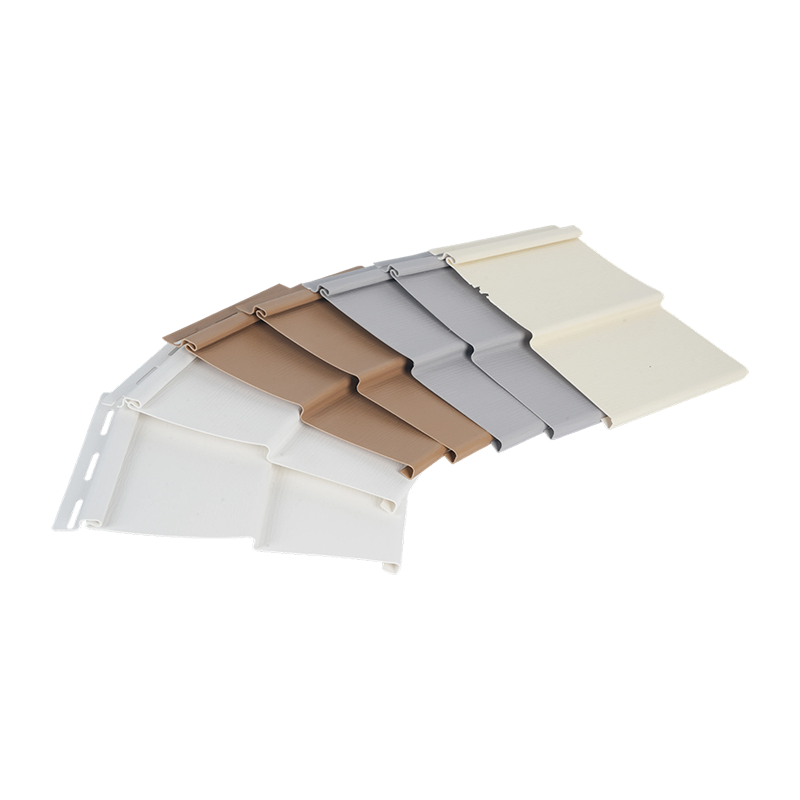
Finding Quality PVC Soffit and Vinyl Siding Components
Quality materials form the foundation of a durable soffit system. Whether you select F-channel or J-channel, pairing it with precision-engineered soffit panels ensures compatibility, reduces installation challenges, and maximizes system longevity.
Frequently Asked Questions About Soffit Channels
Q1: Can I use J-channel for soffit instead of F-channel?
Yes, J-channel can be used for soffit in certain applications, particularly in protected areas like porch ceilings where wind exposure is minimal. However, F-channel is the engineered standard for exposed soffit applications because its structural design provides superior wind load resistance. If you use J-channel, modifications such as additional backing support or supplemental fastening may be necessary. Always verify with your soffit panel manufacturer and local building codes to ensure warranty coverage and code compliance.
Q2: What is the difference between F-channel and J-channel?
J-channel is a universal trim designed for multiple applications, featuring a single receiving slot suitable for siding edges, window frames, and soffit (with limitations). F-channel is purpose-built specifically for soffit-to-wall connections, featuring a deeper receiving slot and additional structural support legs. F-channel provides superior rigidity and wind load performance, while J-channel offers greater flexibility and lower cost. The choice depends on your climate, wind exposure, budget, and application type.
Q3: Which channel is better for vinyl soffit installation?
F-channel is superior for permanent vinyl soffit installations in most scenarios. Its engineered design accommodates PVC thermal expansion, resists wind loads, and maintains panel positioning over decades. F-channel is the recommended standard by most soffit manufacturers and building codes. J-channel remains adequate for low-wind, protected areas and budget-limited projects, but F-channel is the professional choice when durability and performance are priorities.
Q4: Are F-channel and J-channel interchangeable?
No, they are not true interchangeable alternatives, though J-channel can serve as a substitute in limited circumstances. F-channel is optimized for soffit duty with specific receiving slot geometry and structural support. J-channel, while capable of holding soffit panels through friction, lacks the engineered robustness required for high-wind conditions and long-term reliability. Substitution requires consideration of climate, application type, code requirements, and manufacturer recommendations.
Q5: How do I know which channel to use for my soffit project?
Consult these decision factors: (1) Local building codes and wind speed zone classifications (determine if codes mandate F-channel); (2) Soffit panel manufacturer specifications and warranty requirements; (3) Climate and seasonal temperature extremes; (4) Wind exposure (coastal, elevated terrain, or open locations favor F-channel); (5) Application type (porch ceilings are typically J-channel; exposed eaves favor F-channel); (6) Project budget and material availability. When in doubt, F-channel is the safer, more professional choice.
Q6: What expansion gap should I leave for PVC soffit panels?
Maintain a minimum 1/4-inch expansion gap at all channel termination points, including corners, channel ends, and around architectural features. In regions with extreme temperature variations (cold winters or hot summers), increase the gap to 3/8-inch. This clearance accommodates PVC thermal expansion and contraction without causing panel buckling or forcing the trim out of position. Never seal expansion gaps with caulk; use trim pieces or foam backing strips instead.
Q7: How often should I fasten the soffit channel?
Install fasteners every 8 to 12 inches along the channel nail flange. Position fasteners in the center of the nail slot, never at edges, to allow slight movement during thermal cycles. Fasteners should be snug but not driven with excessive force, which can deform the channel or split wood backing. In high-wind zones or for large soffit areas, consider reducing fastener spacing to 6 inches for added rigidity.
Conclusion: Making the Right Channel Choice for Your Soffit System
The decision between F-channel and J-channel for soffit installation hinges on balancing performance requirements, cost considerations, and environmental factors. F-channel is the engineered standard for permanent, weather-exposed soffit systems, offering superior wind load resistance, structural support, and long-term reliability. Its purpose-built design specifically accommodates PVC thermal expansion and ensures professional results that last decades.
J-channel remains a practical alternative for protected applications, renovation projects with budget constraints, and low-wind environments where its universal design and lower cost justify use. However, J-channel requires careful installation technique and may not provide the confidence or warranty coverage that professional installations demand.
Regardless of which channel you select, success depends on quality materials and precise installation technique. Pairing your chosen channel with high-quality PVC soffit and vinyl siding components manufactured to exacting specifications ensures compatibility, reduces installation challenges, and maximizes system performance. Premium soffit panels engineered to standard tolerances work seamlessly with both F-channel and J-channel, but always verify channel compatibility with your material supplier and follow manufacturer guidelines for optimal results.
If your project demands professional guidance or you need technical support selecting the appropriate channel and soffit materials for your climate and application, consult with experienced contractors, material suppliers, or the manufacturers of your chosen soffit system. Investing time in proper planning ensures your soffit installation will perform reliably for years to come, protecting your structure and maintaining curb appeal.